You have probably seen someone at the gym with an elastic band wrapped tightly around the top of an arm or thigh while lifting noticeably light weights. It is not a fashion statement: it is blood flow restriction training, known by the acronym BFR. The promise is to build strength and muscle while lifting a fraction of the load you would normally use, which sounds backward if you grew up believing hypertrophy requires heavy weight. The question that actually matters is whether this works, or whether it is just another trend filling up social feeds without real backing.
What blood flow restriction training actually is
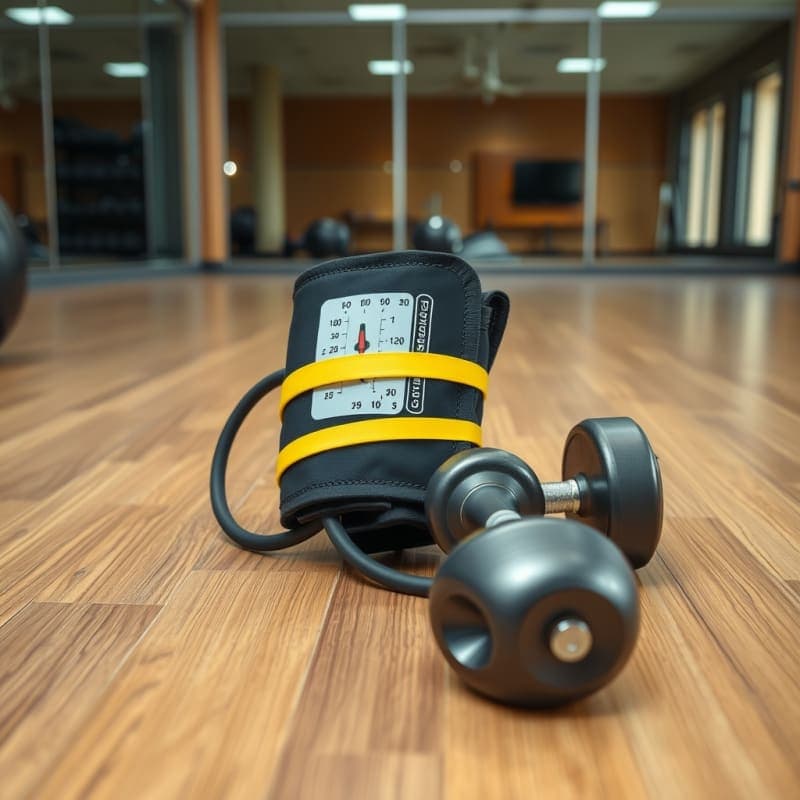
BFR involves placing a tourniquet or pneumatic cuff around the upper part of an arm or leg, inflated to a pressure that partially restricts venous return without blocking arterial blood from entering. In practice, blood reaches the muscle but struggles to leave, creating a buildup of metabolites and a state of partial hypoxia inside the working muscle. That environment, not the external load lifted, is what triggers the adaptations.
The typical protocol used in studies applies restriction during low-load sets, usually somewhere between 20% and 50% of 1RM (the maximum weight you could lift for a single rep), with higher rep counts and short rests between sets. The total volume of work is much higher than normal for that intensity, and that is intentional: the restriction amplifies the metabolic stress of a stimulus that, without it, would be too light to drive meaningful hypertrophy.
What the science says about strength and muscle gains
A systematic review and meta-analysis on PubMed compared BFR training against conventional resistance training across different populations and found strength and hypertrophy gains favoring BFR over low-intensity training done without restriction. In other words: compared to simply lifting light weights with no cuff at all, BFR produces a better outcome, and that finding holds up consistently across studies. The question still under debate is a different one: whether BFR matches, beats, or falls short of traditional training with heavy loads above 70% of 1RM.
Source: PubMed
That same meta-analysis found that conventional high-intensity training still outperforms low-intensity BFR for both strength and hypertrophy when compared head to head. That does not make BFR useless, it just means it has a specific role rather than being a universal replacement for heavy training. An earlier review covering the mechanisms, strength gains, and safety of the method reaches a similar conclusion: the stimulus works, but the size of the gain depends heavily on the pressure and volume protocol used in each study, which still makes direct comparisons across research difficult.
Source: PubMed
BFR is not a shortcut to building muscle without effort, it is a way of making a light load metabolically demanding enough to be worth doing.
Why this matters even if you have no injury at all
BFR originated mostly in rehabilitation settings, where lifting heavy loads is simply not a safe option, such as after knee surgery, with tendinopathies, or in any case where the joint cannot tolerate the mechanical stress of heavy training while the muscle still needs a stimulus to avoid atrophy. That is where the method shows its clearest practical value: it keeps driving hypertrophy and strength while the injured structure recovers, without loading the joint.
But interest has spread to people training with no injury at all for two concrete reasons. The first is accumulated joint fatigue: running a block of training with lighter loads on maintenance days, or when a joint feels sensitive without being injured, cuts mechanical wear without abandoning the training stimulus altogether. The second is logistical: training with little load at home, while traveling, or in any situation without access to heavy weights, using only a restriction band and a light weight or bodyweight.
How the restriction pressure is actually set
A central point of the protocol is that the pressure is not arbitrary: it is calculated as a percentage of each person's individual arterial occlusion pressure (AOP), the minimum pressure needed to fully stop arterial flow in that limb, which varies from person to person. A review on safety and methodology of BFR in athletic populations describes ranges of 50% to 80% of AOP as the most common and studied application, adjusted for cuff width and the limb being trained.
Source: PubMed
This has an important practical implication: wrapping a generic elastic band tight "by feel," with no pressure measurement at all, is far from the validated protocol used in studies. The band ends up tighter in some spots and looser in others, and the actual pressure applied is unknown. Dedicated BFR devices use calibrated pneumatic cuffs specifically to control this variable, which is what determines whether the stimulus is effective and safe or just uncomfortable.
The limits and risks you need to know
BFR is not risk-free, and the literature is clear about separating safe use from careless use. Complete, prolonged restriction of arterial flow, unlike the partial restriction used in actual protocols, can cause nerve damage, clot formation, and tissue injury. People with a history of thrombosis, uncontrolled hypertension, cardiovascular or vascular disease, severe varicose veins, or pregnancy should avoid the method or only use it under the guidance of a health professional familiar with the protocol.
Even in healthy people, the feeling during a set is uncomfortable by design, it is normal to feel burning and intense muscle fatigue within the first few reps, much earlier than in a conventional set with the same load. That is part of the mechanism, not a sign something went wrong, but numbness that lingers after removing the band, sharp joint pain, or skin color changes are signs that the pressure or application time went past the safe point.
How to try it without complicating your training
You do not need to rebuild your entire routine to try this method, it works best as an occasional add-on rather than a replacement for the load-based training that already works for you. A few reasonable ways to experiment:
- Use it on single-joint exercises (curls, knee extensions, lateral raises), where it is easier to position the band and safer to partially occlude just one segment
- Save BFR for reduced-load or deload days, when the goal is already to spare the joint without fully losing the training stimulus
- Start with loads of 20% to 30% of 1RM and sets of 15 to 30 reps, stopping short of true failure on your first attempts to see how your body responds
- Look for a calibrated pneumatic device instead of a plain elastic band whenever possible, and never keep the restriction on longer than the set itself
- If you are recovering from a joint injury, only use BFR under the guidance of a physical therapist or professional overseeing your rehab
Log these BFR sessions separately from your regular training in your workout journal or the app you use to track sessions. Since the load is low, comparing it directly to your normal training weights does not make sense, what matters is tracking perceived effort and rep progression within the restriction protocol itself, so you can tell whether the method is actually adding anything to your training streak over the weeks.
In the end, BFR is neither a miracle nor an empty fad, it is a real tool with a well-described mechanism and favorable evidence compared to light training done without restriction, but with a specific role: useful in rehab, on reduced-load days, and in low-equipment situations, not as a replacement for the heavy training that already gets you results. Understanding that distinction keeps you from both the overselling of the band as a universal solution and the dismissal of something you simply never heard of.