Hip Pain When Squatting: Why It Happens and How to Fix Your Technique | Streak Blog
Injuries7 min read
Hip Pain When Squatting: Why It Happens and How to Fix Your Technique
Why hip pain shows up specifically during squats and lunges, what individual hip anatomy has to do with it, and how to adjust stance, depth, and strength work without giving up on training.
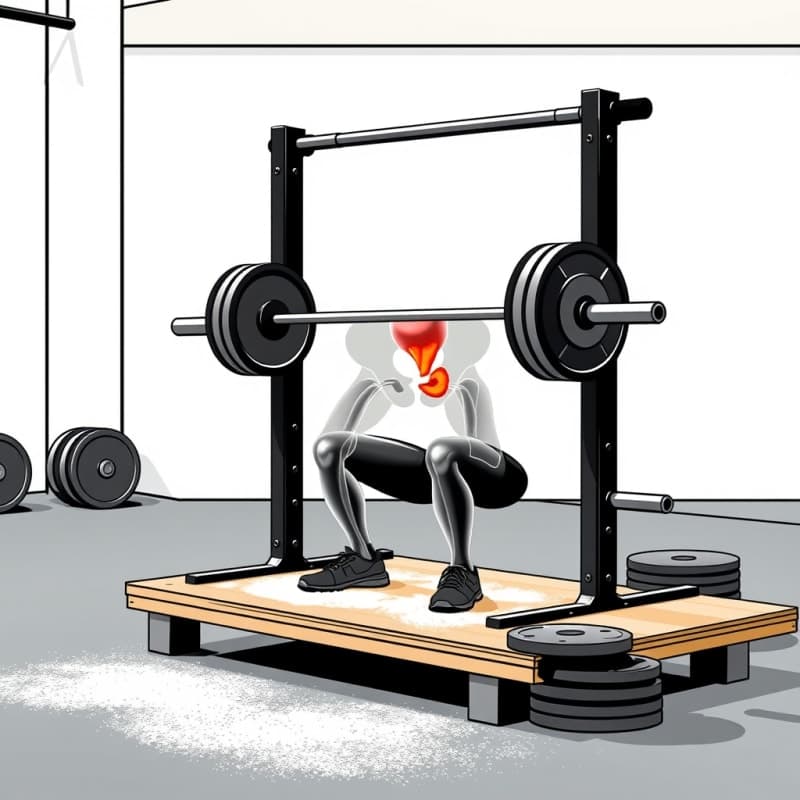
You lower into a squat and, at some point in the movement, feel a pinch at the front of the hip — sometimes on one side only, sometimes on both. It's not thigh pain, and it's not lower back pain: it's in the groin, and it shows up exactly when you try to go deeper or add more weight. It's one of the most confusing types of pain to make sense of, because there's no obvious trauma behind it and it disappears as soon as you cut the range of motion short, which is why people just avoid the movement for good. The problem is that avoiding it doesn't fix the cause, and the cause almost always comes down to how your hip is built — not to a lack of mobility or strength, as people usually assume.
Why the hip hurts specifically during squats
Anterior hip pain during squatting is usually related to a condition called femoroacetabular impingement, or FAI: when the head of the femur isn't perfectly round (cam morphology) or the hip socket is deeper than average, the bony rim of the femur hits the rim of the socket before the movement finishes. This happens in the combination of hip flexion, internal rotation, and adduction — exactly the position at the bottom of a squat or a lunge. The result is a mechanical pinch, not a muscle injury, which is why stretching rarely fixes it: the obstacle is bone, not soft tissue. That's also why the pain shows up at the same point in the movement every time, workout after workout, instead of varying the way ordinary muscle soreness does.
This kind of anatomy is more common than it sounds, and it doesn't automatically mean injury. A study of collegiate athletes found cam morphology in nearly half the hips examined in female volleyball, soccer, and track and field athletes, most with no symptoms at all. Symptomatic impingement, the kind that actually causes pain, was estimated at around 3% of a collegiate athlete population tracked over four years, accounting for nearly 14% of all hip injuries in that group. In other words: having this anatomy is common, but it only becomes a problem when load, range of motion, or posture ask more of the joint than it can tolerate.
The depth that feels comfortable and the stance you take in a squat depend on bony features that vary from person to person: femoral version (the angle of the femoral neck), acetabular version and inclination (the orientation of the hip socket), and the depth of that socket. Two people with the same training and the same mobility can have very different limits for depth and foot stance simply because the bone architecture of their hips is different. That's why the generic instruction to "squat with your feet exactly this wide" ignores the most important variable: the shape of the bone you already have.
In practice, this changes how you should read your own pain. If the discomfort always shows up at the same point in the descent, the first adjustment isn't "train mobility until you can tolerate it" — it's testing a different foot position that shifts the femur's path inside the socket toward an angle without premature bony contact. That's not bad form: it's matching the movement to the anatomy you actually have, the same way two people choose different deadlift bar heights.
Stance, depth, and foot angle: what actually helps
A wider stance usually requires less forward torso lean, because opening the hips shortens the lever arm between the hip and the bar, reducing the demand on the lower back and shifting part of the work to the adductors. For anyone who feels their lower back overloaded in the squat, that's the first thing worth testing. But the recommendation isn't universal: in an impingement-prone hip, widening the stance too much can drive the femur into the socket in exactly the direction where it already hits first, making the pain worse.
That's why the right adjustment is always individual and tested in practice, not copied from someone else's training. Cutting depth back to the pain-free range and shifting foot stance bit by bit until you find the setup where the pinch disappears works better than insisting on a "correct" form that hurts. This applies to both the back squat and the lunge, which put the hip through a similar combination, just one leg at a time.
The squat that works for your training is the one that respects the shape of your own hip — not the one that looks most correct in someone else's video.
The role of the glutes in anterior hip pain
Strengthening the glutes has a direct mechanical effect on this type of pain, and it's not just the generic "strengthen the muscles around the joint" advice. A study that modeled squatting in people with symptomatic femoroacetabular impingement found that glute activation reduces contact pressure inside the hip socket. That happens because a more active glute centers the femoral head within the socket, keeping it from shifting into the position where bony contact happens earlier.
In practice, glute bridges, single-leg hip thrusts, and band hip abductions aren't just a nice warm-up add-on — they change the actual mechanics of the hip during a real squat. Working this in before the main session, not only on isolated leg days, tends to reduce how often the pinch shows up over the following weeks.
Technique issue, injury, or time to see a professional
There's an important difference between the mechanical pinch that eases off once you adjust depth and stance, and pain that progressively worsens, radiates into the thigh or glute, or comes with a painful clicking sensation and instability. The first type usually responds well to the adjustments described here within two to three weeks. The second — especially if it also shows up outside of training, when sitting for long periods or getting into a car — is a sign to see a physical therapist before continuing to self-adjust, since it can involve labral damage that doesn't resolve just by changing your stance.
That doesn't mean stopping training while you look into it. In most cases you can keep other leg exercises going — reduced-range leg press, leg extensions, unilateral exercises without impact — while the hip gets evaluated, instead of cutting leg day out of your routine.
How to adjust without breaking your streak
The biggest mistake in dealing with this kind of pain is treating training as all-or-nothing: either you squat exactly the way you always have, or you stop training legs altogether. Neither option is necessary. Testing small variations, logging which setup brings on the pain in your workout log, and adjusting gradually is the fastest way to keep training without pausing your streak for weeks.
The starting point is simple: treat each adjustment as a one-session experiment, not a permanent commitment. Change one variable at a time — depth first, then foot stance, then warm-up — and give each combination two or three sessions before deciding if it worked. That process is worth keeping track of, so you don't repeat combinations that already proved to be bad.
Cut depth back to the pain-free range before trying to regain range of motion
Test foot stance in 5 to 10 centimeter variations
Add glute activation work (bridges, single-leg hip thrusts, band abductions) before leg day
Swap the back squat for lower hip-demand variations on painful days
Log the foot stance and depth of each session in your workout log, along with the pain level
See a physical therapist if the pain radiates, progressively worsens, or shows up outside of training
Pain that always shows up at the same point in the movement isn't a lack of willpower — it's information about your own anatomy, and adjusting based on it is smart training, not giving up.
A sore hip in the squat isn't a reason to abandon the exercise, nor to push through until some mobility "unlocks" that may never arrive the way the videos promise. It's a reason to test small variations, pay attention to the pain pattern, and strengthen what actually helps hip mechanics. With that kind of adjustment, most people go back to squatting pain-free within a few weeks — without breaking their streak or giving up on an exercise that was working fine before the discomfort showed up.