
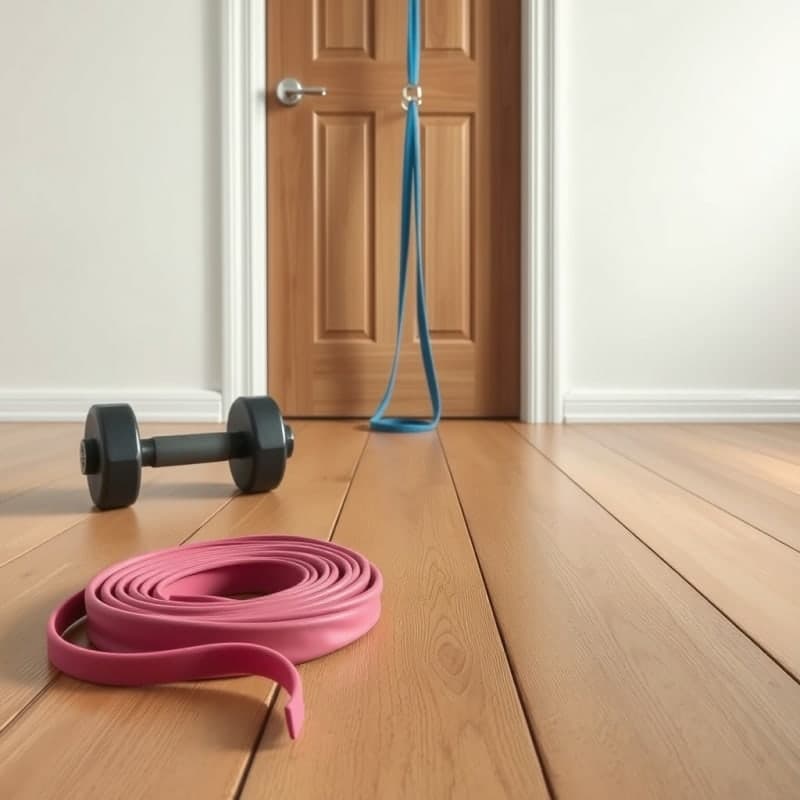
You've probably seen someone training with a resistance band looped around a chair leg, or packed a set of bands in a suitcase without being quite sure whether that could actually replace the gym. Resistance bands have become a staple of home workouts, warm-ups, and rehab programs, but the question few people answer clearly is this: do they really do the same job as a dumbbell or a barbell, or do they just fill a gap when nothing better is available? The answer isn't a simple yes or no — it depends on what stimulus you're trying to create and at what point in the workout.
Why elastic resistance behaves differently
A free weight has a simple property: the resistance it imposes is essentially constant, set by gravity, regardless of the joint angle at any given moment. A resistance band works the other way around — the more it stretches, the more tension it generates, so resistance builds throughout the movement instead of staying fixed. That difference completely changes which point of the exercise loads the muscle the most.
In a barbell squat, the hardest point is usually near the bottom of the movement, where your body's leverage is worst. With a band anchored at the floor, the opposite happens: tension is low at the bottom and climbs to its peak near full extension of the knee and hip. This pattern, known as variable or accommodating resistance, isn't inherently better or worse — it's a different stimulus, one that loads the muscle at a point in the range of motion that free weights usually make easier.
What the science says about strength and hypertrophy with bands
A systematic review with meta-analysis comparing variable resistance training, including elastic bands, with free weight training found no overall difference in muscle activation between the two methods. The analysis did flag one notable detail: activation during the concentric phase, when the muscle shortens to overcome the resistance, was higher with variable resistance than during the eccentric phase and than with traditional free weight training. In other words, the band seems to recruit more fiber exactly where it's stretched the most.
A randomized controlled trial with older adults directly compared resistance band training with free weight training over several weeks of intervention and found significant functional improvements in both groups, with no clear advantage for either method. That result undercuts the idea that band training is a second-tier workout: for building functional strength, it proved just as capable as traditional equipment in that context.
Sources: