You know you need to train, but the motivation never shows up at the right moment. After a full day of work, the gym loses to the couch, to a new show, or to pretty much anything that feels more rewarding right now. The problem isn't a lack of discipline — it's that training competes directly with activities that pay off instantly, and instant payoff almost always wins that fight. There's a simple technique, tested in a controlled field study, that tackles this from a different angle: instead of trying to boost your willpower, it turns the workout itself into the only way to get something you already enjoy.
What temptation bundling actually is
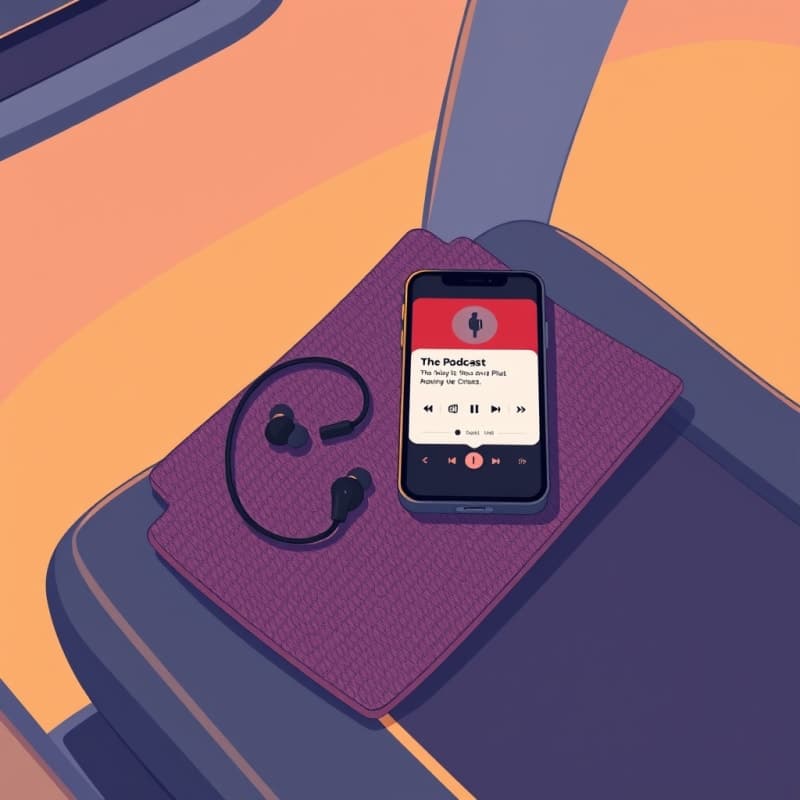
The idea goes by the name temptation bundling. It means pairing an activity you avoid but know you should do with one you love but usually treat as a guilty pleasure or a waste of time. In practice, that means picking a podcast, an audiobook, a show, or any content you genuinely want to consume, and only letting yourself access it during your workout. The gym stops being pure effort: it also becomes the only place where you get to find out what happens in the next episode or chapter.
The logic behind this comes down to how we make decisions in the present. Training carries an immediate cost — fatigue, discomfort, time — for a payoff that's weeks or months away. Watching an episode or listening to a chapter of an audiobook, on the other hand, delivers pleasure right now. By bundling the two together, the workout borrows some of the instant payoff that used to come only from the entertainment, which tips the cost-benefit scale exactly at the moment most people give up: the moment of deciding.
The experiment that put the idea to the test
In a field study run in the United States, researchers gave gym-goers access to gripping fiction audiobooks loaded onto music players, but only inside the gym. Participants were split into three groups: one received the devices restricted to gym use only, another got the same audiobooks with a recommendation to listen to them only while training, and a control group received no incentive at all. Over the following weeks, the group with gym-only access went to the gym 51% more often than the control group, and the group only encouraged to restrict their listening went 29% more often.
Source: PubMed
Why it works (and where it falls short)
The effect, though, wasn't permanent. The researchers themselves recorded a drop in attendance over time, with a sharper decline after Thanksgiving — a period when routines in general tend to fall apart. That points to something important: temptation bundling lowers the friction of getting started, but it doesn't replace a broader habit structure behind it. It works best as an initial push or an occasional boost, not as a standalone, permanent fix for consistency.
Another finding from the same study backs up that the technique has real perceived value. At the end of the experiment, 61% of participants in the treatment groups chose to pay to keep exclusive gym-only access to the devices loaded with the audiobooks. Even knowing the access was artificially restricted, these people preferred to keep that restriction over having full freedom to listen anywhere. That suggests the limitation itself is part of what makes the technique work: strip out the exclusivity, and the incentive loses its pull.
Source: PubMed
Temptation bundling isn't about setting a reward for after your workout — it's about turning the workout itself into the only doorway to something you already want.
How to apply it to your own training
The practical version of this technique is simpler than its name suggests. Pick content you genuinely want to consume — not an educational podcast you feel you should listen to, but something that actually gives you pleasure, like a show, a true-crime series, or an audiobook in a genre you love. Then set the rule: that content only exists during your workout, never outside it, even if the urge to listen hits you in the middle of the afternoon. The restriction is what makes the mechanism work; without it, the content becomes available any time and loses its power to pull you toward the gym.
- Pick content with multiple episodes or chapters, so there's always a reason to come back
- Use this technique for exercises that don't demand full attention, like the treadmill, bike, or elliptical — not during heavy lifts that require concentration
- Rotate the content periodically: the effect fades once the novelty wears off
- Pair it with logging your workout: marking the day on your streak, in an app or a journal, gives you another immediate reason to come back, beyond the content itself
The limits of the technique
Temptation bundling doesn't solve everything. It works well for unlocking the decision to go train, but it doesn't improve your execution or replace a well-structured training plan. It also tends to lose steam on its own, without other routine pillars behind it — which is why it pays to combine it with strategies that already sustain the habit by themselves, like laying out your workout clothes the night before or logging your session right after you finish, closing the loop and keeping your streak of trained days alive.
It's also worth being selective about where you apply it. For exercises that demand refined technique or full concentration, like a heavy squat, listening to a gripping audiobook can be more of a risk than a help. Save temptation bundling for the parts of your workout where attention is more free, and leave the moments that require technical focus free of any distraction.
Exclusivity is the active ingredient: take away the "only here" rule, and the technique loses nearly all its pull.
Ultimately, this technique works because it targets the exact moment when most people give up: the decision to leave the house or get off the couch. It doesn't trade discipline for magic, but it does lower the mental effort of that instant — and, combined with the habit of logging every workout, it can turn a fragile streak into a routine that holds up for much longer.