Squats, deadlifts, bench press, bent-over rows: the exercises that form the backbone of almost every strength program are, with few exceptions, bilateral — both arms or both legs working together under the same load. The logic seems obvious: two legs can hold more weight than one, so why complicate things? In practice, though, almost nobody has both sides of their body equally strong, and always training both sides together can hide that gap for years. The real question is whether training one side at a time actually changes anything, or if it's just another variation to keep a workout feeling "different."
What the bilateral deficit actually is
There's a well-documented phenomenon in the research literature called the bilateral deficit: the force you produce with both sides of your body at once is lower than the sum of the force each side produces on its own. In other words, if your right leg can lift 100 kg alone and your left leg can also lift 100 kg alone, you'd expect to lift 200 kg with both together — but in practice, you usually lift less than that. The most accepted explanation involves the nervous system: when both sides work at the same time, the brain seems to recruit muscle fibers slightly less efficiently than when each side acts alone.
This deficit doesn't show up the same way in every exercise. Multi-joint movements like the leg press and the lat pulldown tend to show a larger bilateral deficit than single-joint exercises like the leg extension — likely because multi-joint lifts demand more stabilization, and splitting that demand between two sides at once costs the nervous system more. That means, depending on the exercise, part of your individual strength potential may be going unused whenever it's performed with both sides at the same time.
Is unilateral training actually better than bilateral? It depends what you're after
A recent systematic review, pooling several controlled trials, compared the effect of training on unilateral exercises directly against their bilateral equivalents. The result pointed clearly in one direction: people who trained unilaterally gained more unilateral strength and single-leg jump performance, while people who trained bilaterally gained more bilateral strength (both legs together). For hypertrophy — the actual muscle size you build — the difference between the two approaches was practically nonexistent.
Source: PubMed
That specificity makes sense once you remember that strength is, in part, a motor skill: your body adapts to the movement pattern you practice most often. If your end goal is lifting more weight in the squat or the bench press — both sides moving together — the most direct path is still training those bilateral lifts themselves and using unilateral work as a complement, not a replacement.
When one side of your body is visibly weaker
Most people notice, at some point, that one arm or leg "helps less" during a bilateral exercise — usually the non-dominant side. This kind of asymmetry is common in people who play sports that favor one side of the body, like kicking, serving, or throwing, and it also shows up for no obvious reason in people who only lift weights. The problem is that, in a bilateral exercise, the stronger side tends to compensate for the weaker one without you noticing, so the gap never gets corrected — it just stays hidden.
A study with female basketball players tested a targeted unilateral training program, with extra volume for the weaker leg, over ten weeks. The program reduced the asymmetry between legs while also improving performance on jump and agility tests — in other words, closing the gap between sides isn't at odds with improving overall performance; the two actually moved together.
Source: PubMed
Correcting the gap between the two sides of your body doesn't get in the way of overall progress — the research shows the opposite: balance between sides and performance gains move together.
How to actually fit unilateral work into your training
You don't need to drop squats or deadlifts to get this benefit — the simplest approach is swapping one or two sets of a bilateral lift for a unilateral variation of the same movement pattern. Lunges, split squats, single-leg leg extensions, single-arm dumbbell rows, and single-leg hip thrusts cover most of the major muscle groups without requiring any special equipment.
- Lunges or split squats in place of part of your squat sets
- Single-leg Romanian deadlifts for the posterior chain
- Single-arm dumbbell rows instead of the barbell bent-over row
- Single-arm dumbbell bench press or shoulder press to spot differences between your arms
- Single-leg hip thrusts for glutes and hip stability
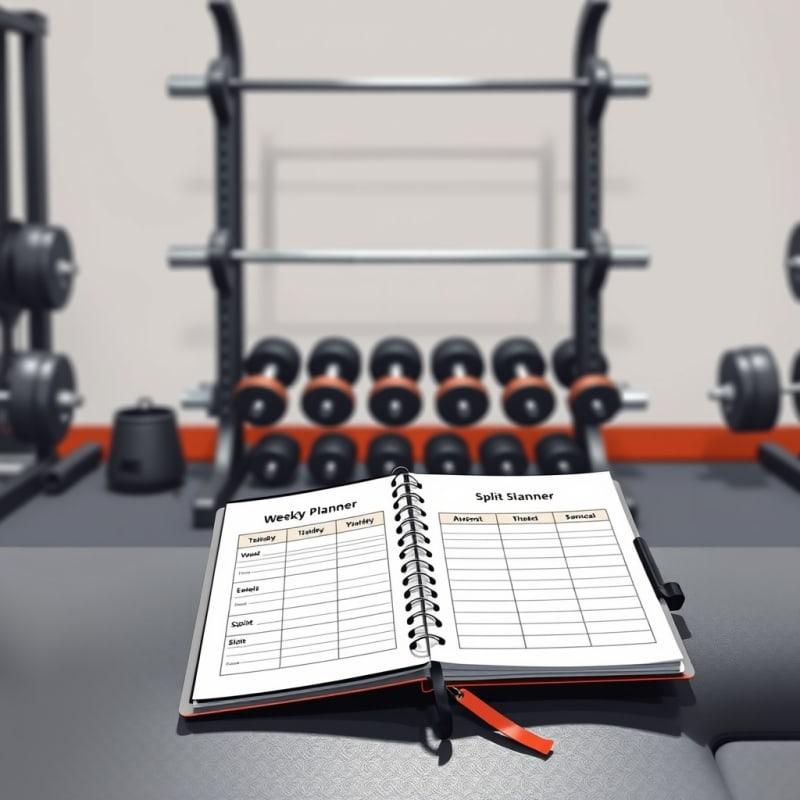
If you notice one side getting visibly more tired, shaking more, or simply falling short on reps compared to the other, it's worth starting the exercise with the weaker side and matching volume between the two — a few extra sets just for it, without forcing the stronger side to do less than it's capable of. If you already log your loads in a workout journal, tracking each side separately is the simplest way to see whether that gap is shrinking over time, with no fancy testing required.
Benefits that go beyond strength
Unilateral training also demands more core and hip stabilization, since your body has to resist rotation while only one side is under load — a stability demand that a bilateral exercise simply doesn't provide, no matter how heavy it gets. For anyone training at home with limited space or equipment, unilateral variations with light dumbbells or just bodyweight can still meaningfully overload a muscle without needing a loaded barbell or a large machine.
This kind of exercise also tends to be gentler on the joints, since the total load handled per set is lower even though the stimulus per side is equivalent — useful for anyone coming back from a lighter training period or who simply prefers dumbbells to heavy barbells day to day.
When it's still worth keeping the focus on bilateral lifts
None of this means swapping bilateral training for unilateral. Powerlifters, for example, need to be strong specifically in the bilateral squat, deadlift, and bench press — that's what gets tested, so that's what needs to be trained most of the time. For most people, the sensible approach is keeping the big bilateral lifts as the base of the program and adding one or two unilateral variations a week, aimed at exactly what bilateral training doesn't reach.
This also matters if your training time is limited: because unilateral exercises work one side at a time, they tend to take longer to complete the same total volume than their bilateral version. In a short session, it can be worth prioritizing the bilateral movement and leaving the unilateral add-on for a session where you have more time to spare.
Unilateral training doesn't replace bilateral training — it completes what bilateral training, by nature, leaves hidden: your weaker side, your stability, and the balance between the two sides of your body.