
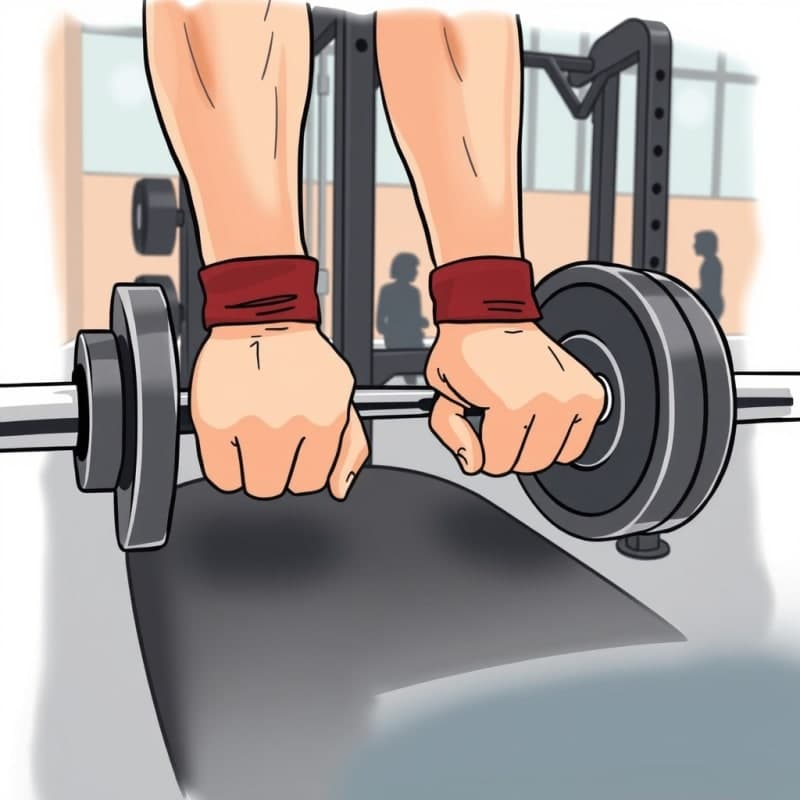
You feel a sharp twinge in your wrist halfway through a set of bench press, or a nagging ache on top of your wrist as you drop into a front squat. In the moment, you adjust your hand angle, finish the set, and move on — until the pain comes back the next week, a little worse. The wrist is one of the most neglected joints in strength training: small, made up of several bones articulating with each other, and built for stability, not for carrying hundreds of pounds rotating on top of it set after set. Understanding why it hurts is the first step to training without turning a small annoyance into an injury that costs you weeks in the gym.
Why the wrist hurts: the mechanics behind the discomfort
The wrist allows four main movements: flexion, extension, and radial and ulnar deviation, toward the thumb or the pinky side. In most barbell exercises, it gets pinned into an extended position — the hand bent back relative to the forearm — while holding a load pushing in the opposite direction. The greater that extension under load, the more tension builds in the tendons and ligaments on top of the wrist, exactly where most training-related pain shows up.
That combination of extension and repeated loading is recognized as one of the main triggers of chronic pain on the dorsal side of the wrist, most common in people who train with high volume and little variation in grip. That doesn't mean the wrist is fragile — it means it suffers when it's forced to compensate for an adjustment that should come from somewhere else, like grip width on the bench press or shoulder mobility on the front squat, the two most common culprits in the weight room.
Sources: PubMed, Stronger by Science
On the bench press, your grip decides whether your wrist pays the price
On the bench press, wrist pain almost always shows up on top of the hand, near the middle of the forearm, and tends to get worse exactly during the heaviest part of the lift — near the chest or coming out of the bottom. The most common cause is simple: the bar sits in the palm, ahead of the forearm line, instead of stacked directly over it. That creates a lever arm that forces the wrist to hold the weight in near-maximal extension, with the forearm working just to keep the hand from folding back.