
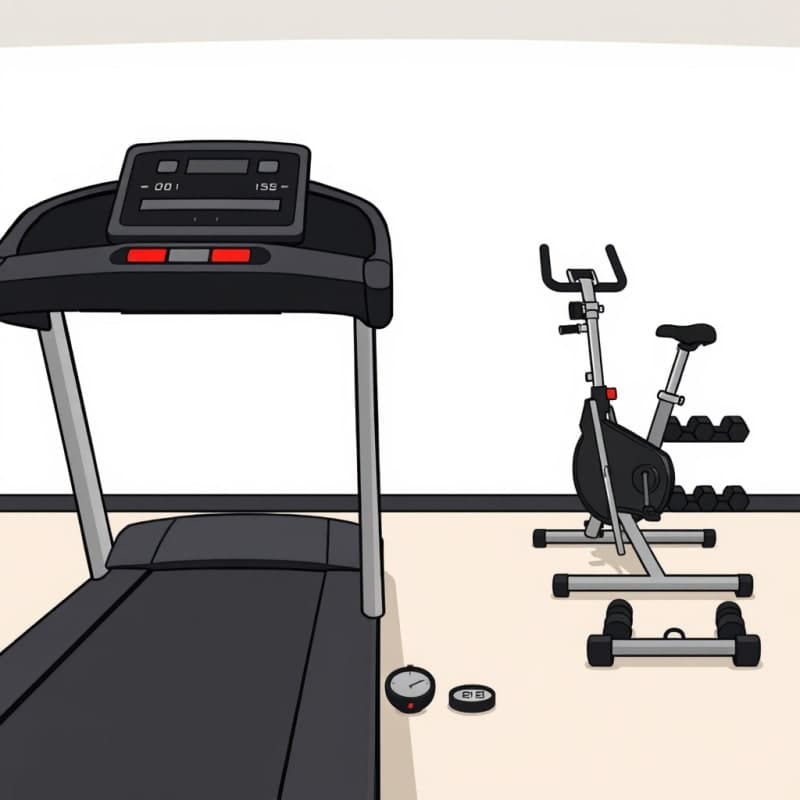
If your week is packed, you have probably combined weights and cardio in the same session: a heavy set of squats followed by twenty minutes on the treadmill, or a run before lifting because that was the only slot left in your day. The question that lingers is whether that combination is sabotaging your results. There is even a technical name for this concern, and the answer is more nuanced than a flat "it hurts you" or "it makes no difference."
What the interference effect actually is
The so-called interference effect describes the idea that endurance training can blunt the adaptations you get from strength training, a phenomenon first described in a classic 1980 study. The most widely accepted mechanism involves acute fatigue and a temporary drop in motor unit recruitment: if you show up to lift already tired from a run or a bike ride, you simply cannot generate the same muscular tension.
The good news is that more recent reviews of the literature have toned down the alarm considerably. For most people, the interference effect does not show up as meaningful for general strength gains or hypertrophy — it appears more consistently in measures of power, velocity, and explosive strength, which are more specific adaptations and more sensitive to accumulated fatigue. In other words, if your goal is getting stronger and building muscle, cardio is not the villain many people assume it to be.
Source: Stronger by Science
Order matters: lift before you do cardio
When your schedule forces you to stack both stimuli into one session, the order in which they happen makes a difference. A systematic review with meta-analysis on the physiological effects of concurrent training sequencing concluded that doing strength exercises before aerobic ones is more effective for muscle strength gains than doing it the other way around. That confirms a simple piece of logic: your central nervous system needs to be as fresh as possible to recruit muscle fibers efficiently, and that matters more for whichever stimulus you actually want to preserve.
In practice, that means on a squat-then-run day, you should knock out your squat sets first and save the run for the end. If cardio is the priority that day and lifting is just a supplement, the logic flips: start with whatever stimulus matters most. The general rule is simple — whatever you want to develop with the highest quality goes first, while your neuromuscular system is still fresh.
Source: PubMed
Running or cycling: the type of cardio changes the equation
Not all cardio weighs on your lifting the same way. Studies comparing high-intensity aerobic exercise done on a treadmill versus a cycle ergometer found differences in the strength performance measured right afterward. Running involves an impact component and repeated eccentric contraction with every stride, which tends to leave more residual fatigue in your leg muscles than a predominantly concentric exercise like cycling.
In practice, if you need to do cardio on the same day as a heavy leg workout, cycling or using the elliptical tends to compromise your following session less than running does. That does not mean you should ban running — just that if it comes right after heavy squats or deadlifts, it is reasonable to expect more accumulated fatigue in the following days than if you had chosen the bike instead.
Source: PubMed
How much time to leave between sessions
The interference effect tends to be largest precisely when both stimuli happen in the same session, with little or no gap between them. If your schedule allows it, spacing cardio and lifting a few hours apart on the same day, or simply putting them on different days of the week, reduces the overlap in fatigue between the two systems and lets each stimulus be processed with more quality.
That does not mean stacking everything into one workout is a serious mistake — for people with a tight routine, the realistic alternative is often doing both together or not training at all. In that case, it is more useful to apply the two recommendations above (lift first, choose low-impact cardio when possible) than to drop cardio or lifting out of fear of interference.
- If you can choose, train cardio and weights on different days, or leave several hours between them on the same day
- When you do need to combine them, do whichever stimulus is your current priority first
- Choose cycling, the elliptical, or rowing over running when cardio comes right after a heavy leg day
- Avoid high-intensity cardio in the hours before an important strength session, like a max-effort test
- Track your loads over the weeks to see whether the combination is actually holding you back
Who this actually matters for
It is worth putting this in perspective before you rearrange your entire week around it. Competitive athletes who depend on power and speed — powerlifters in a peaking phase, Olympic weightlifters, athletes in explosive sports — have a real reason to be careful about how close intense cardio sits to strength training, because those are exactly the capacities where the interference effect shows up the most.
For someone training for general health, more muscle, and more everyday strength, without a meet or a competition to prepare for, the effect tends to be small enough that it does not justify much anxiety. In that case, the variable that decides the outcome is still the same one it always is: showing up and training consistently, with or without cardio on the same day.
Sequencing your session helps, but no amount of order optimization makes up for weeks of skipped workouts.
How to apply this to your own routine
In practice, the most important decision here is not the fine science of the interference effect, it is keeping both habits — lifting and cardio — alive over time. Logging every workout, including what came before and after it, helps you spot real patterns in your own performance instead of deciding everything from theory. If after a few weeks you notice your strength numbers stalling specifically on the days you run before training legs, that is when it is worth adjusting the order or spacing the sessions apart.
It is also worth remembering that keeping your streak alive matters more, in practice, than chasing the perfect combination of exercises. A combined strength and cardio session done consistently, even if the order is not ideal, still beats a theoretically perfect workout you abandon after two weeks.
Combine lifting and cardio without guilt: the order optimizes the result, but consistency is what makes sure it shows up.
