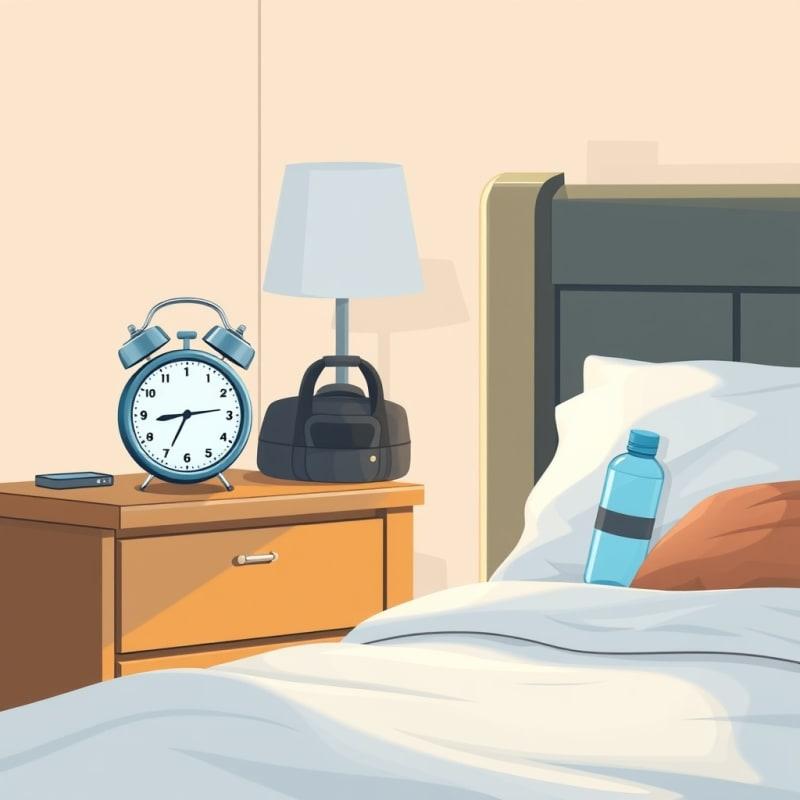
You slept badly, the alarm went off, and the gym is already on your schedule. Part of you wants to cancel, and part of you is afraid of losing momentum if you do. Both automatic answers tend to backfire: skipping after every bad night becomes an easy excuse, and training as if nothing happened raises the odds of a poor, frustrating, or even risky session. This article helps you decide in a few minutes what to do after a short night, and how to adapt your workout without dropping the routine.
What a bad night actually changes in your training
Losing a night of sleep doesn't erase your strength overnight, but it often makes your performance noticeably worse. Systematic reviews and meta-analyses that pooled dozens of studies found, on average, a negative effect of acute sleep loss on physical performance. Results vary a lot from study to study, and that matters: some people feel a large drop, others barely notice anything, and the type of task and the length of the deprivation change the picture.
One practical detail shows up in those reviews: the effect tends to be clearer in the afternoon than in the morning. In other words, the more hours you spend awake and tired before you train, the higher the risk that the session comes in below your usual level. If you sleep badly and train early, the damage may be smaller than you fear; if you train late in the day, accumulated tiredness usually weighs more.
Sources: PubMed, PubMed, PubMed
There is also a difference between a bad night and a bad week. In a study of trained women, nine consecutive nights of restricted sleep mainly reduced bar velocity rather than total volume lifted, and it also raised perceived effort at the same relative intensity. That study looked at prolonged restriction, so it doesn't answer the one-night question directly, but it shows the mechanism: your body can still move the weight, only at a higher cost and with lower quality on each rep.
Source: PubMed
Why the workout feels heavier than it is
The most common complaint after a poor night is that everything feels harder: the warm-up is tiring, the first set feels heavy, and motivation disappears. That has a basis. A recent meta-analysis of athletes and non-athletes found that sleep deprivation worsens performance and also raises ratings of perceived exertion, meaning the same task feels like it costs more. A classic study had already shown that, after sleep loss, walking on a treadmill with a load was rated as harder even though heart rate and metabolic rate had not changed.
Source: PubMed
This has a direct consequence if you train by perceived effort, such as RPE or reps-in-reserve scales. On a bad-sleep day, a set can feel two reps from failure when there is still room to spare. The opposite can also happen: coordination and attention get worse, and a load you normally handle can feel less stable. Because your sense of effort becomes less reliable, the best move is to lower the ambition of the day and pay more attention to technique than to the number on the bar.
After a bad night, the goal of the session changes: it stops being about setting a record and becomes about keeping your commitment with quality.
Train, scale back, or rest: how to decide
One simple rule prevents most bad decisions: ask yourself whether the problem is just tiredness or whether there are signs of illness or risk. Tiredness, sleepiness, and a bad mood usually allow an adapted session. Fever, strong dizziness, palpitations, or an intense headache are reasons to rest, and you don't owe anyone an explanation for that.
For the in-between cases, ask these quick questions before you leave the house:
- How many hours did you sleep? If it was only a little less than usual, train normally and watch how your body responds during the warm-up.
- Is today's workout heavy and technical, like squats and deadlifts close to your limit? Consider swapping in simpler exercises or lowering the load.
- Will you drive or do work that needs intense focus afterward? Very long, exhausting sessions make sleepiness worse for the rest of the day.
- Did the warm-up improve how you feel after ten minutes? If so, carry on; if you feel worse, shorten the session and stop.
Notice that none of these answers requires courage or willpower: they are objective criteria you can apply even with a foggy head. The more defined the criteria, the less you depend on your mood in the moment to decide.
How to adapt the session without dropping the routine
The ideal adaptation keeps the habit and cuts the risk. In practice, that means still showing up and lowering the demand: fewer sets, a load slightly below your usual, and longer rests between sets to make up for reduced concentration. A short, well-executed session still counts as a workout and still preserves the pattern of showing up on the days you planned.
It also helps to choose exercises that demand less coordination under fatigue. Machines and guided movements are safer than complex free-weight lifts when your attention is low. If today's session was meant to be max strength, turn it into a lighter version of the same movement pattern and leave the load progression for another day when you are rested.
- Cut volume by about a third, dropping one or two sets per exercise instead of removing whole exercises.
- Keep a larger reserve of reps: stop further from failure than usual.
- Do the most important exercises first, while your attention is at its best.
- End the session if your technique visibly starts to break down, and make a note so you can adjust the next workout.
What not to do to compensate
The most common mistake is trying to fix the lost sleep with stimulants and intensity. More coffee and heavier loads may mask sleepiness for a few hours, but they don't give back the recovery the night should have provided, and they tend to disrupt the following night. If your sleep is already poor, pushing your body even harder can create a cycle where you sleep worse because you're tired and train worse because you slept badly.
Another mistake is treating one bad night as permission to stop for several days. Missing a workout is just one fewer workout; the problem starts when a bad night turns into a week off. If poor sleep has become your normal, training isn't the culprit, and it's worth looking at bedtime, light, screens, and routine before you touch your exercise plan.
A short, adapted session is worth more than a perfect workout that never happens.
Logging the bad night is part of the plan too
Write down how many hours you slept alongside your workout, and how the session felt. Within a few weeks you'll have your own data: how many bad nights really drag down your performance, what time of day the effect hits hardest, and which adaptation works best for you. That log replaces the daily morning doubt with a pattern you already know.
This is also where the logic of a workout streak really helps. Keeping a streak doesn't require the same intensity every day; it requires showing up and logging it. A light session on a poor-sleep day keeps the streak alive, protects the habit, and saves the heavy training for when your body is ready for it.