Almost every group of friends has tried a workout challenge: someone starts a group chat, sets a goal for the month, everyone is fired up in week one, and by week three the chat is a graveyard of unread messages. The problem is rarely a lack of willpower. More often, the challenge was built without thinking about who is taking part, how progress shows up, and what happens when someone slips. This article covers how to design a challenge among friends that survives once the initial excitement fades.
Why a group challenge changes behavior
Training alone depends on an individual decision, made every day, usually at a moment when you are tired. A shared challenge changes the math: skipping stops being a private choice and becomes something other people can see. That visibility creates a light commitment, because nobody wants to be the first to vanish, and it also gives you a concrete reference for what a normal pace looks like for the group.
There is a less obvious effect too: a challenge gives you something to talk about together. When someone posts that they trained even on a bad day, the barrier drops for everyone else, and training stops being a solitary effort and becomes a small shared task. This works in a group of two or fifteen, as long as the rules are clear and the way of keeping score makes sense to everyone.
A randomized clinical trial called STEP UP compared three forms of gamification with social elements, based on support, collaboration and competition, against a control group. The authors reported that all three increased physical activity during the 24-week intervention, with competition the most effective, and that only the competition arm stayed above control at follow-up.
Source: PubMed
Competition, collaboration or support: which to pick
There is no single winning format for every group. Direct competition, with a ranking of who trained the most days, tends to work well among people of similar fitness who enjoy competing. Collaboration, where the whole group has to hit a shared target, protects beginners because the result does not hinge on the strongest member. Support, where everyone chases their own goal and the others just cheer, is the lightest format and creates the least friction.
A good rule of thumb is to look at the gap in fitness inside the group. If someone is far ahead, a pure ranking tends to demoralize everyone else within a few weeks, because the final standings already look decided. In that case, compete on consistency rather than volume: the winner is whoever completed the most planned sessions, not whoever lifted the most weight or ran the most miles.
The data on effect size calls for humility. In a trial of 1,779 medical interns, team competition raised average daily steps by about 106 compared with no competition, a real but small gain. In another randomized trial, the authors concluded that incentives combining individual and team performance worked better than either one alone, which suggests mixing personal accountability with shared accountability.
The best challenge is not the fiercest one, but the one everyone still wants to play in week six.
The problems that sink most challenges
The first culprit is a goal that is too ambitious. Agreeing to train every day of the month sounds exciting on Sunday and turns into punishment at the first cold, work trip or holiday. When someone breaks the goal early, the tendency is to abandon the rest of the challenge, because the feeling of having already lost has set in. Goals with some slack, like five sessions a week instead of seven, protect the motivation of anyone who has a bad week.
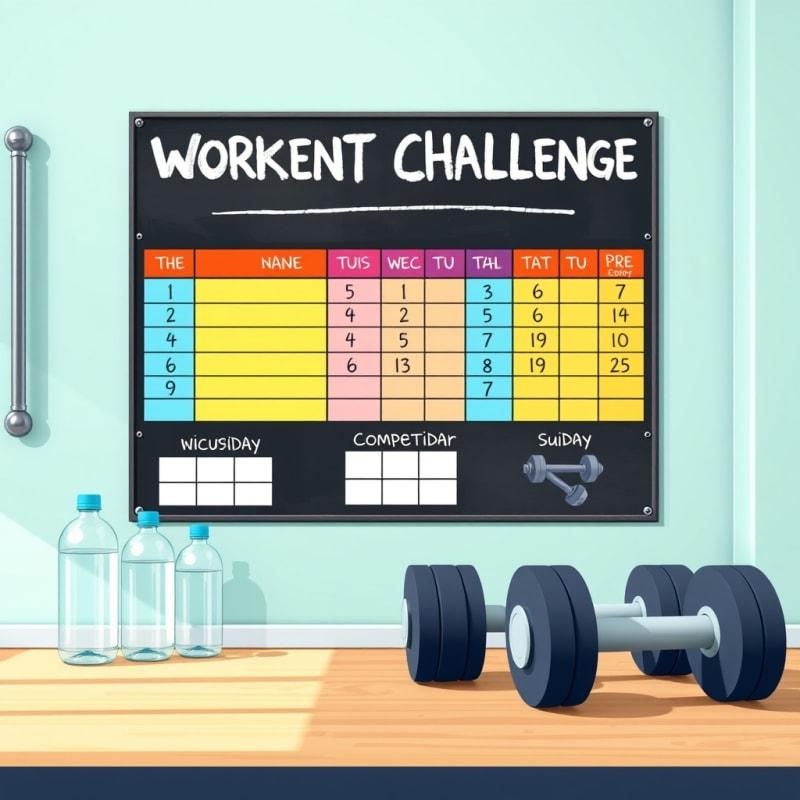
The second culprit is the lack of a reliable way to record what each person did. If proof of a workout depends on someone's goodwill to post a photo or remember to tell the group, the challenge turns into an argument about who said what. A simple, low-friction log that everyone can check removes that friction and leaves the conversation for what matters: encouragement.
How to build a challenge that lasts
A challenge works best when it is short, has written rules, and plans for what happens when someone slips. Four weeks is usually enough to build rhythm without wearing the group out, and it is easy to renew the deal at the end. The key is to decide everything before you start, while nobody is annoyed with anybody.
- Set a weekly goal with some slack, such as four workouts of at least 30 minutes, instead of a rigid daily target.
- Agree on what counts as a workout before you begin: lifting, running, a long walk or a group class, so nobody argues later.
- Pick a single place to log workouts and keep it visible to the whole group.
- Create a comeback rule: anyone who misses a week starts fresh the next one with no penalty, so nobody quits for good.
- Schedule a wrap-up get-together, even if it is just a chat, to celebrate whoever kept the pace and agree on the next round.
Avoid expensive prizes or humiliating punishments. The goal is to keep the workout streak alive, and a simple reward, like coffee after the last session, is usually enough. Public penalties tend to push away exactly the people who need the group the most.
Where workout tracking fits in
Every challenge depends on a clear answer to one question: who trained today? When that information lives in everyone's memory, the group ends up trusting whoever talks the loudest. A shared history, like the workout streaks in Streak, turns the conversation into something objective: everyone can see how many days in a row each person has trained, without having to nag anyone.
That record also helps after the challenge ends. Looking back at the month shows which days of the week were hardest for the group and where the next agreement should be adjusted. People who leave a challenge with data in hand start the next round knowing what worked, instead of relying on a vague memory that it was tough.
A good challenge does not test who can endure the most; it makes it easy for everyone to show up again next week.