Once kids enter the picture, training is usually the first thing to fall off the schedule. Not because you stopped wanting to train, but because free time became scarce, and any hour not spent with the family starts to feel selfish. The problem is treating training and family time as if they compete for the same slot — that's a false choice. You can combine the two, and the payoff isn't just your own fitness. It's what your kids pick up about their bodies and about consistency, without you ever having to say a word about it.
The example your kid is copying without you noticing
Kids don't learn activity habits from being told to go move — they learn by watching what the adults in the house actually do. A review that pooled dozens of studies on the topic found a consistent link between parents' activity levels and their children's, though the effect is moderate and varies quite a bit from family to family. In practice, that means telling your kid to "go play outside" carries less weight than them watching you walk, bike, or train on a regular basis.
That influence isn't equal between mothers and fathers, either. A study of families found that fathers' activity levels were more closely linked to their sons' activity, while mothers' activity tracked more closely with daughters' — meaning both adults in the house carry their own share of that example, not just one of them. In practice, that kills the excuse of "my partner is already active, so we're covered": every adult a kid sees at home counts separately.
How much movement kids actually need
The official recommendation for children and adolescents aged 5 to 17 is an average of 60 minutes a day of moderate-to-vigorous physical activity, mostly aerobic, across the week, plus muscle- and bone-strengthening activities at least three times a week. That sounds like a lot if you think of it as standalone "exercise," but it's a low bar once you count everything that already counts as movement: walking to school, playing at the park, climbing stairs.
Source: WHO/OMS
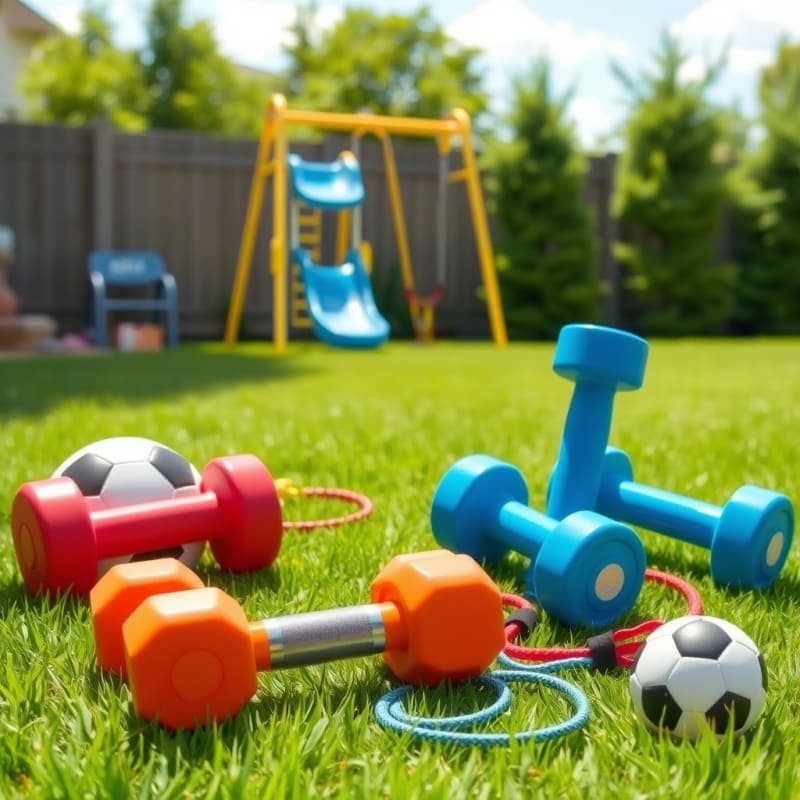
This is where merging your routine with theirs turns into strategy instead of sacrifice. A family bike ride, a short weekend hike, or a game of tag in the backyard count fully toward that target for your kids, and they also work as your cardio for the week. You don't have to choose between "my workout" and "time with them" every single day — you just need to spot which blocks of the week can serve both at once.
Strength training for kids: what's actually safe
Plenty of parents avoid any strength work with their kids because they've heard that lifting weights stunts growth or hurts a developing body. That fear doesn't hold up — what determines the risk isn't the category "strength training," it's how the program is designed and supervised.
The NSCA's position on youth resistance training states that a well-designed, supervised program is relatively safe for that age group, and that for pre-pubescent kids the focus should be on technique and building the habit of training safely, not on the load lifted. That completely changes what "training with your kids" can mean: it's not putting an 8-year-old under a barbell, it's using their own bodyweight as the load and teaching them the right movement pattern.
Source: NSCA
- Swap external load for bodyweight: squats, knee push-ups, planks, and lunges with no added weight
- Treat the playground as a training station: the bar, the stairs, and the bench already work as equipment
- Let your kid copy your basic movements without a stopwatch or a rep count to hit
- Supervise every time, and stop at the first sign of pain — fatigue is expected, joint pain isn't
- Praise technique, not the load or the number of reps
Building the routine without it turning into chaos
Pick a fixed time slot that's non-negotiable from the start, like Saturday morning before any other plan gets made, instead of trying to squeeze training into whatever gaps the week leaves — those gaps rarely exist once there are kids in the house. Letting your kids pick the activity now and then, from a short list you're fine with, boosts their buy-in without forcing you to give up what the session needs to be.
Not every session needs to be shared. Alternating between workouts that are entirely yours, with real focus and real load, and sessions explicitly built for the family, more playful by design, is enough to hold onto both goals at once — the example doesn't depend on training together every day, it depends on being seen training on a regular basis.
The streak you build while hiding your training from the rest of the house teaches your kids a lot less than the one they actually watch you keep.
When your kid doesn't want to join in
Forcing participation tends to backfire: the kid starts associating exercise with a chore instead of something the adult chooses to do of their own will. It works better to offer a short, playful alternative and to accept a "no" without turning it into an issue — the autonomy of choosing is part of what makes physical activity stick long term.
What matters more in the long run isn't how many times your kid joined your workout, it's how many times they saw you training at all, even alone in the living room or the backyard. Dropping your training because that time felt "stolen" from the family teaches less than keeping the routine visible, however small, on the days nobody wants to join you.
The workout your kid sees doesn't need to be perfect — it needs to be visible and repeated.
Logging your workouts — yours, and whenever it makes sense, the activities your kids did alongside you — helps make that consistency visible to the whole family, not just something that lives in your head. That kind of shared streak, built from plain repetition rather than perfection, tends to outlast any New Year's resolution by a wide margin.