Almost everyone who trains at home hits the same wall: push-ups that were once a real challenge turn into a set of 30 reps done on autopilot. Your body has adapted, the workout feels easy, and it seems like there's nowhere left to go without dumbbells. In practice, the problem is rarely missing equipment. It's the lack of a rule for making the exercise harder in a controlled way. This article shows how to progress with bodyweight training using the same logic the gym applies with plates, only by adjusting other variables.
Why the push-up stops working
Muscle grows and gets stronger when it receives a stimulus it hasn't mastered yet. If you've done the same push-up for months and finish the set with plenty left in the tank, the stimulus has dropped below what your body can already handle, and adaptation stalls. It's the same principle as progressive overload with weights, except your bodyweight is a fixed load: it doesn't go up on its own when you get stronger.
That's why bodyweight training seems to work so well at first and then plateaus. Instead of adding pounds, you have to change the leverage, the support, or the tempo of the movement. Each of these changes how much of your weight your arms actually push, and that's the gradation of difficulty a barbell and plates would give you at the gym.
One study analyzing forces and muscle activity in push-up variations measured this difference: with 8 men, the initial load relative to bodyweight was 66.4% in the standard push-up and 52.9% with the knees on the floor. The sample is small, but the practical point is clear: resting on your knees or raising your hands lowers the load, and doing the opposite raises it.
Source: PubMed
The progression ladder: change the leverage before you chase more reps
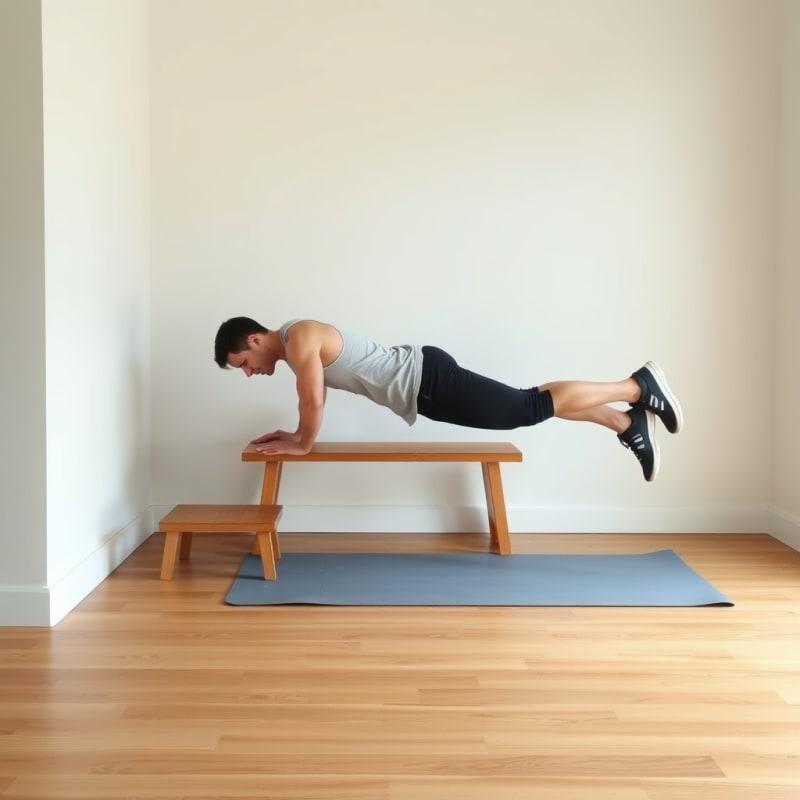
The simplest way to organize your progress is to build a ladder of variations, from easiest to hardest, and move up a rung only when you hit your planned reps with good form. Start with push-ups with your hands elevated on a wall, a countertop, or the back of a sturdy couch. The higher the support, the more weight shifts to your legs and the less your arms have to push.
As you get stronger, lower the support: from the couch to a chair, from the chair to the floor on your knees, and from your knees to a full push-up. Once the standard push-up gets easy, the direction flips: put your feet on a step to shift more load onto your arms, slow down the lowering phase, or add a pause at the bottom. What matters is changing one variable at a time, so you know what actually made the exercise harder.
- Keep your body in a straight line from head to heels, without letting your hips sag or pike up.
- Lower yourself under control for about 2 to 3 seconds, bringing your chest close to the floor or the support.
- Move to a harder variation when you complete all planned sets with the same quality of movement.
- Change only one variable per workout: support height, tempo, pause, or number of reps.
- If your form breaks down before the last rep, drop back a rung next session instead of pushing through.
How many reps, and how close to failure
Bodyweight training usually means light loads, and light loads call for longer sets to stimulate the muscle. Long sets aren't a problem in themselves. What changes is the standard: with light loads, effort matters more, so stopping well before your arms start to burn tends to pay off less than getting close to your limit.
A systematic review and meta-analysis found that maximal strength gains were greater with high loads than with low loads. A separate study comparing the two approaches showed that taking sets to muscular failure produced more hypertrophy in low-load training, but not in high-load training. Translated to your living room: if your push-up is too light for the strength you already have, get close to failure, but remember that to get really strong, a harder variation with fewer reps tends to help.
In bodyweight training, what you increase isn't the number of pounds: it's the difficulty of the leverage and how close you get to failure.
Can push-ups replace the bench press?
This is a common question for people who train at home, and the honest answer is that it depends on what you're measuring. One study compared the bench press with band-resisted push-ups, matched to demand similar levels of muscle activity, and found similar strength gains in both groups over a 5-week program.
Source: PubMed
The result comes with caveats: it was a short study, and it used band-resisted push-ups rather than a plain push-up. Even so, it supports the central idea of this article, that exercises can be swapped when the load and effort are comparable. If bodyweight is all you have, your job is to make the push-up hard enough, not to give it up because it doesn't feel like a serious exercise.
How to track your progress so you don't stall again
Without a log, bodyweight progression turns into guesswork. Write down the variation you used, the reps per set, and how hard it felt. A simple rule helps: when you complete all the sets in your plan with clean form for two sessions in a row, it's time to move up a rung on the ladder. A rule like that removes the doubt about when to progress.
Tracking also helps you keep your streak going. Seeing your consecutive training days in Streak next to the variations and reps you logged shows that you're improving even when one particular week feels flat. And if a session goes badly, the history reminds you that one below-average workout doesn't erase the weeks before it.
When training gets easy, don't add hurry: move up a rung on the ladder and log what changed.